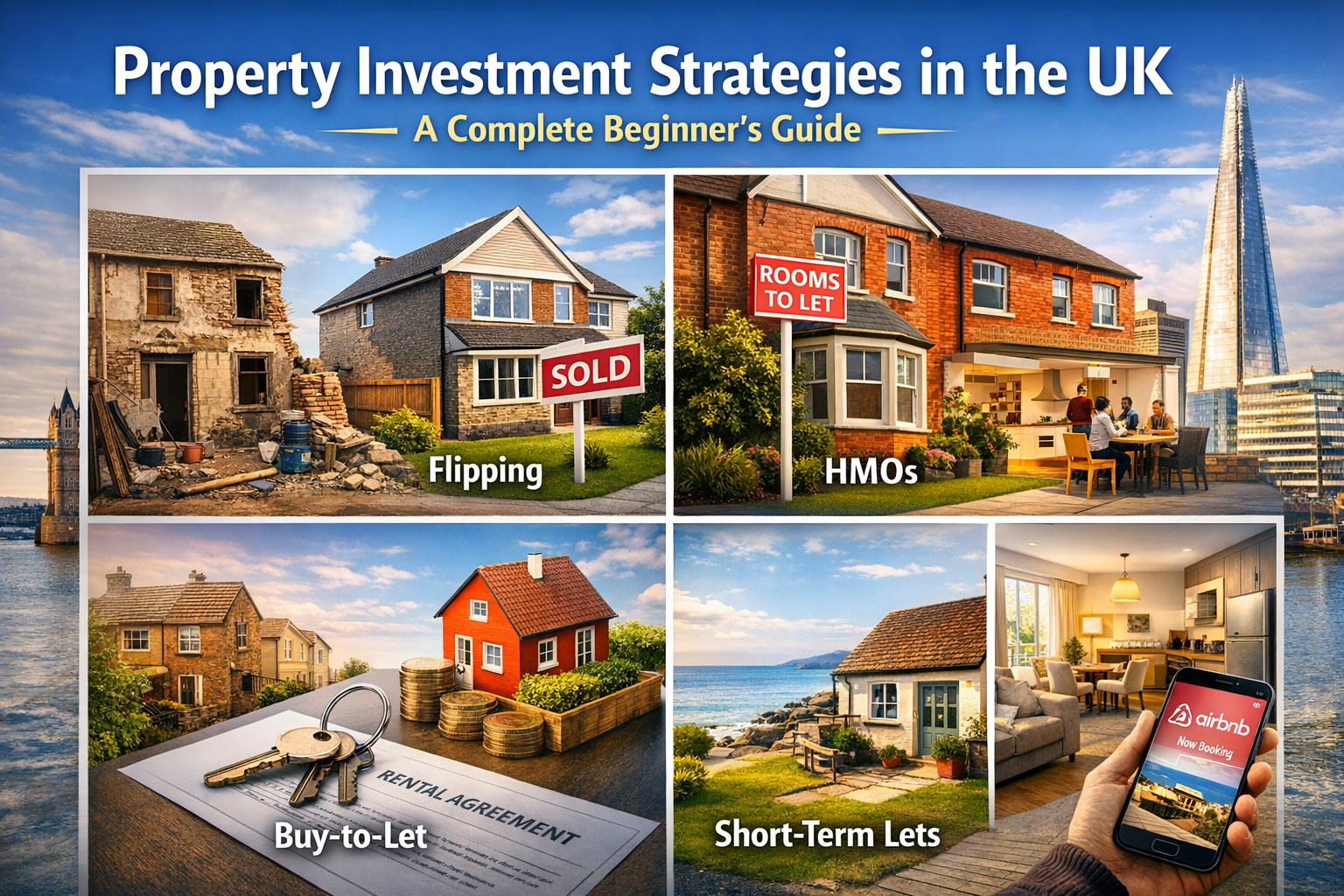
If you've already assessed where you are financially and set your property investment goals, there's one critical step left: deciding how you're actually going to achieve those goals. This is where your property investment strategy comes in.
In property, you can buy a property, but how you use it determines your results. Understanding the main strategies available in the UK — and which one fits your situation — is what separates investors who build successful portfolios from those who get stuck.
Why Property Strategy Matters More Than You Think
Property investing offers many different strategies. That's both the best thing and the worst thing about property. Too many options can lead to confusion, poor decisions, and procrastination. So instead of getting stuck, you need to understand each strategy clearly and choose what fits you.
1. Property Flipping (Buy, Refurbish, Sell)
This is one of the most well-known strategies in the UK, popularised by property renovation programmes. The basic process is straightforward: buy a run-down property, spend money renovating it, then sell it for a profit.
To do this well, you need either strong refurbishment skills yourself or a reliable network of tradespeople. Delivering renovations on time and within budget is critical — mistakes can be expensive, and you can lose money just as easily as you can make it.
Flipping also requires significant capital and time. When the UK property market slows, there are fewer transactions and properties are harder to sell, which makes this strategy more challenging (though not impossible).
The upside is the potential for large profits on individual deals. The downside is the high risk, time commitment, and level of expertise required.
One important variation that many investors overlook: you don't always have to sell after renovating. An alternative approach is to refurbish, refinance, and then rent the property out. Many experienced investors look back and wish they had held more properties long-term rather than selling them.
2. HMOs (Houses in Multiple Occupation)
An HMO means renting a property room by room rather than as a whole unit. Instead of one tenant paying for the whole house, you have multiple tenants each paying for their own room, which typically generates significantly higher total rental income.
HMOs are well-suited to investors who want strong monthly cash flow. However, they come with considerably more complexity than a standard buy-to-let. Different types of HMOs exist, regulations vary across local authorities, licensing may be required, and some areas actively restrict new HMOs.
From a finance perspective, HMOs require specialist mortgages that are harder to arrange and calculate. Converting a property to HMO use also requires legal permissions and setup work. Ongoing management is more demanding too — tenants move in and out more regularly, conflicts can arise, and more day-to-day oversight is required. You can manage an HMO yourself or hire a management company, though using an agent will reduce your profit margin.
A common subtype is the student HMO. Student tenants often move as a group, which simplifies some aspects of tenancy management. The challenges include void periods during summer months, the need to plan well in advance (students typically book early), and increasing competition from purpose-built student accommodation.
The key insight with HMOs: higher income comes with higher complexity. Think of it as property investing on hard mode.
3. Buy-to-Let (Simple and Proven)
Buy-to-let is the most common and beginner-friendly property investment strategy in the UK. The process is simple: buy a property, use a mortgage to leverage your capital, rent it out, and hold it for the long term.
It's popular because it's easy to understand and execute, and it delivers stable, predictable results. It's particularly well-suited to busy people who don't have a lot of time to manage a complex investment.
One important insight that many beginners miss: the real long-term wealth from buy-to-let comes from capital growth, not just rental income. The rent is a bonus that helps cover costs. The main wealth driver is the increase in the property's value over time.
Buy-to-let is also a forgiving strategy. If the market dips, you don't need to sell — you simply continue renting. Property prices in the UK have historically recovered over time, which makes this approach relatively resilient.
When choosing a buy-to-let property in the UK, look for areas with strong job markets, good schools, and solid transport links. These factors drive both rental demand and long-term property value growth.
4. Short-Term Lets (Airbnb and Holiday Lets)
Short-term lets cover a broad range of property types: holiday cottages in rural or coastal areas, city centre apartments rented to tourists, and properties let to business travellers. Instead of a long-term tenancy, you rent the property nightly or weekly, typically at a higher rate per night than a standard tenancy would yield per day.
The appeal is higher cash flow combined with long-term capital growth. In the ideal scenario, a well-located property stays fully booked year-round, generating strong income while also appreciating in value.
The challenges are significant, however. Short-term lets require much more management effort, frequent changeovers between guests, and more complex setup. They also require specialist mortgages, which typically come with higher interest rates. If you're considering a flat, always check the lease — many leases prohibit short-term letting entirely.
The biggest risk is occupancy. You need consistently high occupancy rates throughout the year for this strategy to outperform buy-to-let. If your property only attracts guests during peak season, you may end up earning less than a standard buy-to-let while doing considerably more work.
No Strategy Is Perfect
Every property investment strategy involves trade-offs:
- Flipping — potential for high profit, but carries high risk and requires significant expertise
- HMOs — higher rental income, but much greater complexity and management overhead
- Buy-to-let — stable and reliable, but wealth builds more gradually
- Short-term lets — can generate high income, but demands high effort and carries occupancy risk
There is no objectively perfect strategy. The right choice depends entirely on your circumstances.
How to Choose the Right Strategy for You
To decide which strategy suits you, ask yourself the following questions:
- How much time do I have available?
- How much capital can I deploy?
- Do I want cash flow now or long-term wealth building?
- Am I comfortable with complexity and hands-on management?
Your honest answers will point you towards the right strategy. Don't choose a strategy because it sounds exciting or because someone else is doing it — choose the one that genuinely fits your life.
Don't Try to Do This Alone
If you're unsure which strategy to pursue, speak to experienced investors, attend property networking events, and learn from people who have already built portfolios using different approaches. Getting access to the right knowledge early helps you make better decisions faster and avoid costly mistakes.
Final Thoughts
Your property investment strategy is the bridge between where you are now and where you want to be. Once you understand each strategy clearly, choose the one that fits your goals and situation, and commit to taking consistent action, you give yourself a genuine opportunity to build a successful UK property portfolio.
The strategy is not the destination — it's the vehicle. Choose yours wisely.



Get Free Local Property Insights
Thinking of buying or selling? Get area-specific advice tailored to your needs.